

IM® 6–8 Math v.360
A coherent middle school math curriculum designed to deepen student discourse and problem-solving as students grow.
Independently reviewed. Rated all-green.
As an independent nonprofit, EdReports evaluates instructional materials for alignment to standards and other indicators of quality, helping educators make informed curriculum decisions.

See how learning builds across IM 6–8 Math v.360

Grade 6
Grade 7 work with proportional relationships, operations with signed numbers, and geometry.

Grade 7
Grade 8 work with linear relationships, functions, and transformational geometry.

Grade 8
High school work in statistics and linear, exponential, and quadratic functions.
A two-year pathway to Algebra 1
For districts wanting students to reach Algebra 1 by grade 8, IM 6–8 Math Accelerated v.360 makes that possible without cutting standards.
Accelerated compresses the full grade 6–8 sequence into two courses, taught in grades 6 and 7. It covers every grade 6–8 standard. The pace is faster, but no concept is dropped, so students arrive at Algebra 1 having worked through the complete middle school progression rather than a shortened version of it.
Acceleration decisions carry real risks around placement, bias, and disproportionality. IM’s guidance addresses those directly, and we recommend reviewing it before adopting an accelerated pathway.

Accelerated 6

Accelerated 7
We have a vision of the graduate at East Hartford involving things like effective communicator, collaborative team member, self-motivated learner, curious inquirer. All of these things are embodied in IM Math.

Secondary Math Curriculum Supervisor,
East Hartford Public Schools
What makes IM Math different
 Coherent by design
Mathematical ideas build across lessons, units, and courses, helping students experience mathematics as connected rather than fragmented. IM’s curriculum, professional learning, and IM Certified partner ecosystem are also built around that same instructional model.
 Grounded in decades of research
IM Math draws on established research on how students build mathematical understanding, including problem-based, discourse-rich instruction. That foundation extends to embedded supports for English learners and students with disabilities, including math language routines and UDL-aligned guidance.
 Written by a lead writer of the standards
IM Math was created by mathematicians and educators, including Dr. Bill McCallum, a lead writer of the Common Core State Standards for Mathematics.
 Designed for classrooms, not shareholders
IM Math is built by a nonprofit, so every decision about content, sequencing, and support is made to strengthen student learning, not to satisfy investors or drive sales.
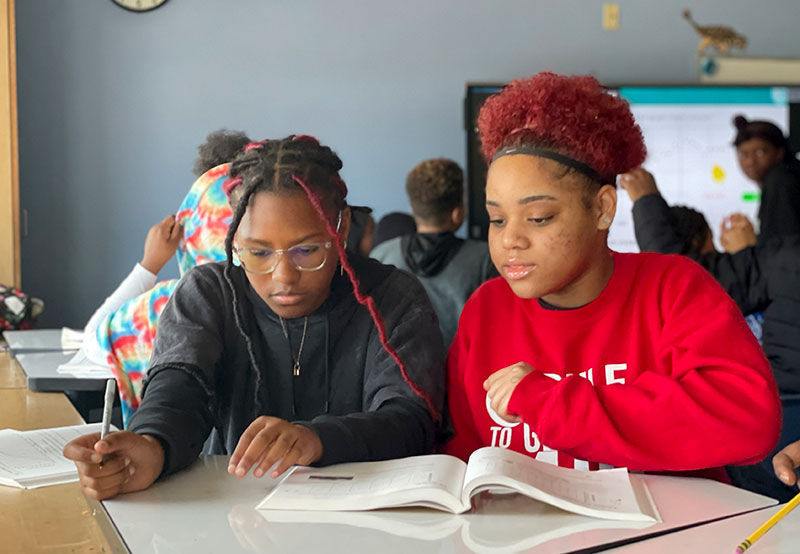
Understanding and fluency, built together
IM Math is designed so conceptual understanding and procedural fluency develop together, each strengthening the other. Students learn why a method works as they learn to use it, building speed and accuracy through practice that’s woven into every unit.
Daily routines build fact fluency. Distributed practice—returning to key skills over time instead of drilling them once—strengthens automaticity while freeing up working memory for harder problems. In middle school, practice sets deliberately revisit problem types from earlier units so that retrieval stays active between topics. Students learn why and how the standard algorithms work, so fluency holds up over time instead of fading after the test.
That’s what coherence looks like in practice: students build understanding and fluency together, with the curriculum reinforcing both over time. The result is stronger, more durable learning.
THE TAKEAWAY
Understanding and fluency are built to reinforce each other, and the results follow from that design.
Measurable results, by design
Math proficiency in grades three through eight rose from 25.8% to 50.6% between 2022 and 2025, nearly doubling the share of students scoring proficient.
LA schools using IM Math outperformed similar schools in math growth.
An analysis from Leanlab Education found LAUSD schools using IM Math gained an additional 3–4 months of math learning compared with their peers.
See IM 6–8 Math v.360 in a real classroom
Grade 7
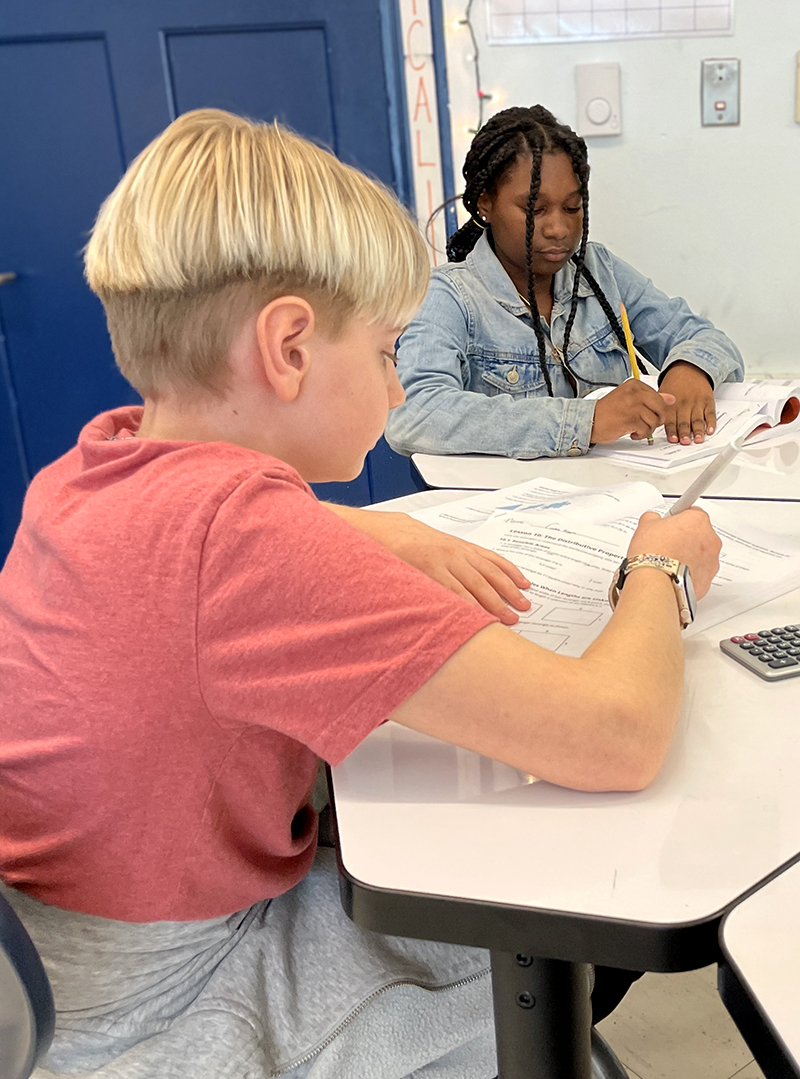
A grade 7 class works through two related situations, comparing strategies and justifying their thinking before the teacher guides a synthesis.
Get IM Math v.360 for your school or district

Access IM Math for free
Access the complete IM Math curriculum online at no cost, including full lessons, printable PDFs, and implementation resources.

Explore enhanced print and digital options
Explore professionally printed materials, enhanced digital platforms, and implementation support for IM Math.
Need help choosing a path?
Tell us what your school or district needs, and we’ll help you identify the right option.
The team
Meet the IM 6–8 Math v.360 authors

William G. McCallum
Cofounder and curriculum contributor

Kristin Umland
Cofounder and curriculum contributor

Kate Nowak
6–12 curriculum lead author

Yenche Tioanda
Grade 6 lead

Michelle Mourtgos
Grade 7 lead

Ashli Black
Grade 8 lead
Contributors
Contributor
Jacqueline Bumler
Contributor
Monica Caplan
Editor
Cole Chase
Writer
Ryan Colón
Writer
David FitzSimons
Writer
Lynn Frankel
Editor
Writer
David Petersen
Writer
Max Ray-Riek
Writer
Lizzy Skousen
Writer
Elisa Smith
Writer
Sonja Twedt
Writer